THE LAZIEST MAN HAS THE BEST DOG
WSN interviews John Thomas
The photos in this article have been put into thumbnails so the article will load faster. Click on the photo if you wish to see a larger version and use the back button in your browser to return to the article. Thank you.
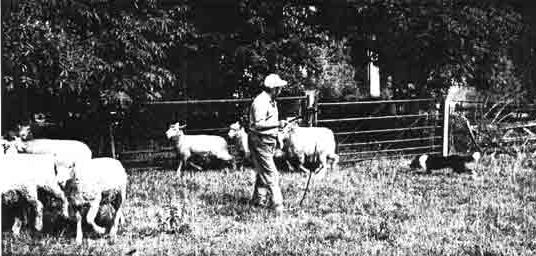
John Thomas puts young Coon through his paces at his Colesbourne home
We didn't think it sensible to come back to East Yorkshire between the Welsh and English Nationals this year, so spent a couple of days in the Gloucester area between the two events. We enjoyed an all too brief visit to Barbara Carpenter in the lovely Forest of Dean, and took the opportunity to interview John Thomas at Colesbourne. It is obviously good luck to be interviewed by WSN just prior to a trial, and John duly triumphed in the English National a few days later!
Colesbourne is attractively situated between the towns of Gloucester and Cheltenham, near to the Roman Villa at Chedworth and boasting an intriguingly and unusually named pub "The Hungry Horse". There was no need to sample their fare, however, for, upon our arrival at Home Farm, that ubiquitous hospitality always experienced at our interviews was in evidence and plentiful tea and cake placed before us.
Refreshments duly consumed we sat back in the comfy chairs and the serious business began!
WSN: How do you go about training a young dog?
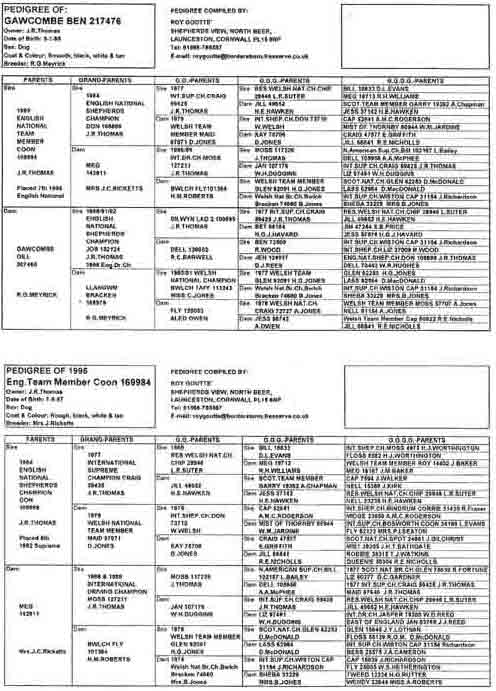
JT: I don't start a dog until he's about eight to twelve months old. It all depends. Sometimes he'll go just over twelve months. I want him so he is coming at me whenever I can get to train him. It is very difficult to find dogs that will take you as a person. The only dogs I've got are my own breeding. I'm not trying to be clever when I say that ‑ the other ones don't suit me. They won't accept me A lot of people might think I'm hard on them. So I am in a way, but I don't knock them about. I don't believe in it. I don't like to see people at them at them all the time. It's like children. If you're at them all the time they don't take any notice.
When I start a dog off, it doesn't even know its name. It hasn't been on the lead or anything. I just take the dog out and let it loose on some sheep. I've got another dog with me and I've got a whip, and I keep the trainee back with the whip. I don't say a word, just let the dog go and if it comes in when it's not supposed to I just flick the whip ‑ I never hit with it, Just flick it. I don't crack the whip unless I'm in trouble.
I do that about twenty times just to get him going naturally around the sheep, and then I start to work him in a small part of the field without the trained dog, with me in between him and the sheep and teaching him to keep back with the whip ‑ twenty yards ‑ I want to make Sure I've got that distance all the time.
I still say nothing. I don't know if I'm doing right or wrong but that's how I do it. Then I bring him out into the middle of the field and get him to go round and that's when I put left and right on him. Having got left and right on him I leave him to go back to being natural ‑ being able to bring the sheep to me. When I have got the left and right, I want it to be without a sheep moving.
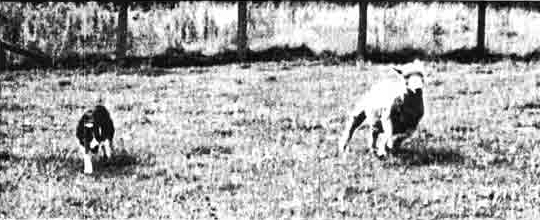
Gawcombe Ben holds a sheep lie has just singled
Once I get the sheep moving, I want the dog to go the opposite way to what the sheep are going, because it's my belief that you haven't broken a dog until he goes the opposite way! He'll naturally go the way the sheep are moving ‑ you've got a hell of a job to bring the dog back the other way, but once you've got that, you've got the dog under control.
Then I just do everyday work with him He'll do two months of everyday work. I'll let him be natural and pick up sheep on his own, so that I've got that natural ability back and then I'll go back and reinforce that left and right. I like the dog to come forward and I don't stop the dog that's something I don't believe in, not until later. I want to see the dog working all the time. I think there are too many dogs lying down while the people do the work. We are losing tile natural ability in the dog. It annoys me and I want to emphasize this point.
My profession is being degraded by it. I'm not saying I am better than anyone else, I don't mean it like that, but it annoys me to see people degrading what I have been doing all my life. Just look at the difference between the Scottish boys and our lot. Whether we like it or not, we are going to have to face facts. There is something radically wrong. You have about half a dozen Scotsmen who can knock spots off us every tune. There's a reason ‑ they're better than we are. I am the last of the old school. The modern handlers are the very opposite to what I was taught. I was always told the laziest man has the best dog. He makes the dog do all the work. If the modern shepherd had to do the same as I had to do ‑take the sheep to market along the road (and I wasn't the only one, there was a heap of us) and put the sheep in the pens and if we didn't sell them, we brought them home again; he would need a good dog.
Now they say you can't do that because of the traffic on the roads. I quite agree but traffic call be stopped. We used to shepherd on the backs of horses when shepherding ‑ nobody used a quad bike or land rovers or anything like that. Dogs walked. They were fit. A lot of dog foods have lots of protein ‑ they don't need it in my opinion. It's the handler who'll need the protein, and soon he'll need running shorts and spiked shoes as well. I've never seen people running around like they have these last few years in the shedding ring. If you'd done that when I started, that would be it! The dog just lies there and the man runs around. Soon we'll have the dog at the post and the handier fetching the sheep. Totally wrong. We have moved away from what 'it was meant to be.
Partly it's because of the hobbyists, but also because we've been brought up differently. As soon as I was 3 1 was out with the sheep. That was all we thought about ‑ you didn't know anything else. There was no television, no video. When you were about 9 or 10 you went to Young Farmers. Everybody walked or rode a bike. It's a different way of life.
We're going totally wrong. In twenty years time, well it won't be troubling me then but I don't know what it will be like. I've seen a big difference in the time I've been trialing. The dog is only as good as the handier will allow it to be. The do is supposed to shed the sheep, but the dog is oil the opposite side and the man is between the sheep. That's the wrong way to do it. Who is shedding the sheep? The man!
If I had my way, there'd be no ribboned sheep. I'm talking about the International Qualifier now. You'd stop the last two for the shed and the last one for the single. Some clever lass said to me "How do you know it's the last one?" I said "When four beggars have gone past you know it is the last one!" When three have gone past it's the last two. All they're doing is making excuses.
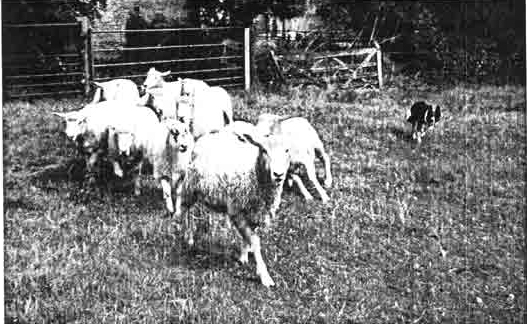
Coon reacts instantly to prevent a break
In Scotland years ago, and I expect it's still the same today, I used to go to Glasgow trialing, and, by Christ, if you didn't take them off the back end, you'd go back and do it again. Why have we changed'? To make it easier.
When you get to the final day of the International, you're supposed to let the unmarked sheep go and Pull the dog in on the marked sheep. You watch how many people actually do that. Johnny Wilson did it last year ‑ that was the only good thing about that trial!
We need to address the problem, but nobody is willing to do so. They go on about money, money all the time. I'm not knocking those that come into the sport, Of Course they've got to come in. Instead of expecting their standards to come Lip to those of the true shepherds, we've dropped the standards to their level.
Les Suter and W J Evans did a lot for me. W J Evans wasn't a very likeable bloke but he could run a dog. He was such a perfectionist. Now I feel we've moved away from that and changed the type of dog which is being run. It isn't so much the dogs as the people. My dogs would be no good to those who live in the town. They work every day but are the type to breed from. If we don't,
we'll go finer and finer. Look at the amount of people who have come into trialing who aren't involved with sheep ‑ obedience people and so on.
WSN What about the question of reward and censure for the dog?
JT: I never praise a dog for doing good. I threaten it for doing wrong. Take those boys front Scotland with their dogs. How far away are they from the dog?! How the hell can they keep saying "Good dog" all the time'? I put a stick on my dog's back and just tap him on the side to let him know he's all right. He knows when he's wrong. There's no need for all this fuss and giving of tidbits it’s wrong for a working sheepdog.
I don't know what's gone wrong at the 'top' of England. They've got the facilities but something is radically wrong. Do you remember Charlie Houseman'? Nice old boy. I can remember him and me getting one handler's sheep out of every corner of every field and that's what it's NOT about. We are getting dangerously near the time when the Animal Welfare lobbyists will stop us. Bad handling is abusing the sheep, but you can't seem to get people to see that.
You go to an ISDS Directors' Meeting ‑ all that is talked about is money. That's not what it should be about. It should be one person running his dog against another in sport. Nowadays, a lot of folk make trialing their work, their business. The saying used to be "No good flock without a good shepherd and no good shepherd without a good dog." We've forgotten that ‑ it's a shame.
WSN: Going back to the training, you must find that some dogs won't take the treatment you give them
JT: They go to somebody else.
WSN: You won't be waiting to see if they develop?
JT: No. I don't keep that sort. I keep those that develop a natural manner to them. I'll show you a dog after. He's two years old. Terrible! A lot of people say a dog which grips is wrong. When you're by the hill gate trying to get a few thousand sheep in, and you've got a dog which won't come through to sheep, you believe me; you're not going to get them through the gate. If you've got lambs running back ‑ that's what a lot of dogs have never had ‑ I've seen six hours gathering and dogs knackered by the hill gate, but if sheep won't go through with lambs running back, you need some good dogs to stop them!
WSN: This brings it’s to the perennially controversial subject of gripping at trials.
JT: It is up to the discretion of the judges. If I was judging and a ewe tried to go past the dog and he stopped it by the head, I would say 'good dog'. I might even give him an extra point! There's not many people think like that. Out on the hill, if a ewe is in lambing difficulties, you need a dog to hold her but a lot of folk don't understand that.
WSN: There's a lot of difference between a decisive grip on the nose and pulling wool off the flank.
JT: Of course. If the dog grabs by the arse, he's wrong. This is what I want to say about the shed. The dog is supposed to come in on the last sheep and stop it. Some say that's no good, that the dog should turn it. How, when the sheep is going away from the dog, can that be? The end of the sheep is to the dog to start with!
Old Charlie Relph, sadly gone; now you wouldn't wish to meet a nicer chap, but Charlie thought that if a dog even thought of gripping it should be called off. I'm sorry I don't agree. But the dogs I've got would be no good to someone like Charlie. His dogs would be no good down here. There's so much stone and rock down there that my dogs would be dead ‑ they'd be watching the sheep and "bang" that would be the end of that!
WSN: So, when you've got the young dog in training and you think lie's going on all right, then a fault develops ‑ lie stops listening or becomes too excitable. How do you counter it?
JT: Use the whip ‑ the main tool. Not as a stick, more as a fishing rod. Tie a bootlace on the end and, if he comes in too tight, just shake the whip. It's not an abusive method, it's corrective. There's no need to use it on the dog at all. A lot of people criticize the electric collar. The point is, the person who is using it often has no reins. The person is abusing his power, it's not the collar. I have seen those who do far more damage with a stick than you could do with a collar. With an electric collar, if it is used PROPERLY, the dog will not associate you with the bang.
WSN: I suppose the danger with the collar is that people use it as a short cut to training, instead of a last resort to stop a specific thing.
JT: I don't know. I haven't got one but I have used one. If it weren't for the electric collar that dog would not have been broken in. He would have been shot. I was out training him and he gripped a ewe by the neck and wouldn't let go. I had to get down on top of him with my knee in his neck to make him let go. What would you have done with that dog? The only reason that I stuck to him was because they said I'd never break him. That was just what I wanted! If you get one like that and you do succeed in breaking him, that is the dog to have! A lot of the dogs I have had have been like that.
Old Craig I got for L 25 because nothing could be done with him. Dilwyn Lad, I bought him off Howell Havard because he'd had a stroke and couldn't work him. I had Cap off Harold Hawkins, which was another one which couldn't be managed.
WSN: And these are the best dogs, once sorted out, because they've got power and initiative?
JT: That's entirely right. A lot of people thought Don (108889) was weak. He wasn't. When that dog was about 6 months old, I was in Ross on Wye and moving some cattle. I had my old Cap and Dilwyn Lad, moving 80 cattle and I was coming up onto the road. What the hell I wanted to take this Pup with me at 6 months old for I don't know! The biggest beast there was 3 years old, near enough 17 hands high ‑ a great big thing he was. Of course Don had to take on the biggest one. The pup walked on, head down and tail underneath, and the bull put his head down and "boof!" the dog had him on the nose. Instead of letting go, he hung on and the bull came down on top of him. I went to him and saw the blood coming out of the corner of his eye and his ears. He was stone cold. I thought "That's him dead" but I had to go on because the cattle had gone onto the road. When I went back the pup wasn't there. I could see him by the cattle grid at the bottom of the field. I picked him Lip and how he'd come round I don't know. I put him on the box on the back of the tractor and brought him home and put him in some bales. His stomach was getting bigger ‑ he was bleeding internally. The following day I took him to the vet who injected him but didn't like his chances. He said "If he's still alive tomorrow, bring him back." I just kept him quiet and you know the rest. How he survived I don't know but he was a hard dog. He'd stand his corner but he wasn't a vicious dog. If they wanted it the hard way they could have it the hard way.
Once I brought a trailer down for 4 ewes and twins. As he brought them up, one ewe turned on him and had a go at him a few times. I whistled him to come on and she let him have it. Dog underneath, ewe on top. He took her by the throat and got himself free. I loaded her onto the trailer, stitched her up and injected her with Penicillin. She was OK. So, Don would stand his corner and he took a lot of managing but we suited one another.
I could have had any amount of dogs when I was breeding off him, because people would say "Have the b‑‑‑‑‑‑ thing back. I can't do anything with him." One was ten months old and had collie back from Scotland. He'd got in with some other dogs and Fight!! Did they fight?! That was a good dog, called Craig. I sent him to America and he won a lot of cattle trials. You could single cattle with him and take them where you wanted them to go. A single or a cow and calf ‑ it made no difference. I went out to America 3 years after he'd left me and they didn't have the right whistles on him and all I did was whistle and call that dog. His ears came up and he looked for me He had lead pellets in him where they'd shot at him to try and stop him. I put him back on the whistles he was trained on. People like that shouldn't have a dog. Don't ask me why they changed his name and his whistles, this was 20 years ago. Now we send out the whistles on tape.
The important point is that you don't know the faults of a dog until you've bought him. Then you know why the bloke's sold him!
WSN: This is what is said about Dalziel's Wisp. That lie was a difficult dog and a lot of people have gone to him as a stud clog, but will have trouble sorting the progeny.
JT: Well, I'll tell you. If Dalziel hadn't had him he would have been gone. These boys in Scotland have a lot of hard dogs. They've got to. If you are going to try to break pups from them, you have to understand that. No good their going to a town, because people can't manage them.
WSN: That's partly the sadness of the Border Collie isn't it? Programmes such as "One Man and His Dog " have maybe made them too popular People think they're easy to train.
JT: I quite agree with you. Getting back to the standard of trialing, though, I am concerned that things aren't being done properly and standards are falling. It's the same at the International. If you go back to the 1960s and 70s, there were about three people who didn't finish. Now there are about three people that do finish. Why? Can you tell me? Often the penning is terrible. People say if the man opens the gate and the dog is round the back and the sheep run in you can't take his luck away. I would, because the dog shouldn't be there in the first place. I don't know if anyone is willing to take the initiative and turn things round. The qualifying system is right and the rules are made, but there are those who push them as far as they can. They call it gamesmanship, but I call it wrong. If you've got a better dog than I have then good luck to you, that's what I say. I've seen people come off after a bad run crying! Well! That's wrong isn't it?! It shouldn't be like that at all.